

When Kitara FC began searching for a striker capable of making the difference in big matches, Jimmy Kalema had already built a reputation as one of the deadliest finishers in the Airtel Masaza Cup.
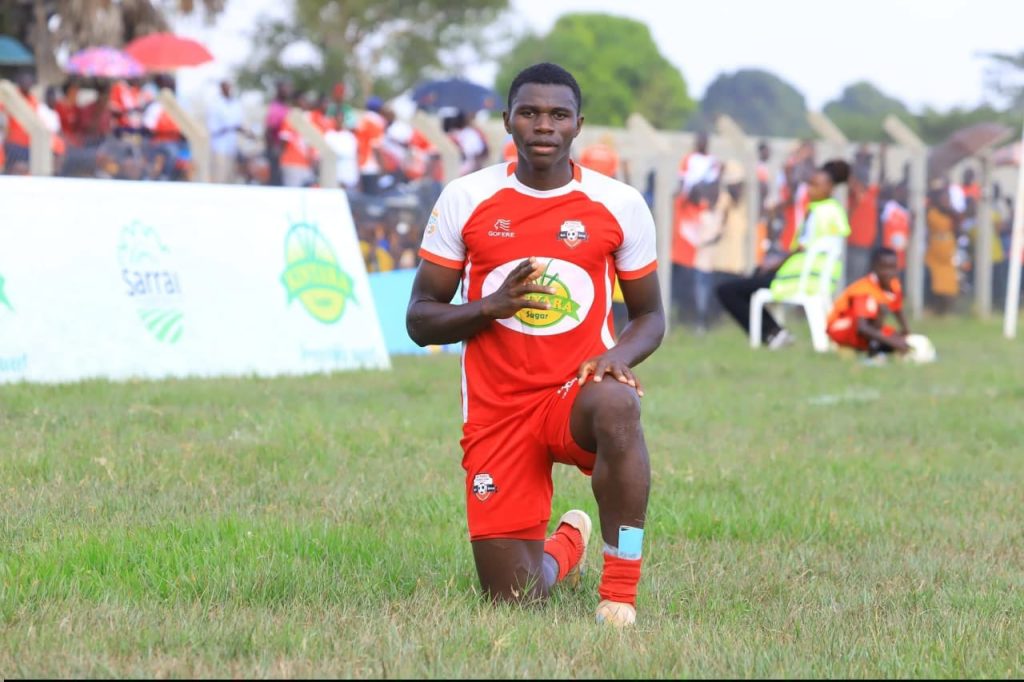
That reputation has since been justified. Within months of joining the Hoima-based club, the 23-year-old scored the decisive goal that secured Kitara’s second Stanbic Uganda Cup title, adding another landmark achievement to a career that has accelerated at remarkable speed.
Kalema’s emergence has been one of Ugandan football’s most compelling stories. Still only 23, he has already collected two Airtel Masaza Cup winners’ medals, won the tournament’s Golden Boot and Most Valuable Player award, and established himself among the country’s most exciting attacking talents. Yet, behind those achievements lies a journey that began far from packed stadiums and television cameras.
Growing up in Kiboga under the care of his mother, Teopista Birungi, and his late father, Ben Kimuli, Kalema developed his love for football in village playgrounds. Few would have predicted he would become a prolific striker because his football education started in defence.
While attending a local academy during primary school, Kalema operated as a left-back until one coach recognised his natural eye for goal and moved him further up the field. It proved to be a career-defining decision.
His education took him through St. Andrews Primary School, St. Paul Kyamutwe (Rock Base) and later St. Balikuddembe Primary School in Kyankwanzi before balancing school with competitive football at Kiboga United.
His performances in the FUFA Regional League quickly caught attention. While still studying at Light Secondary School and later Vienna Secondary School, Kalema struck 11 goals for Kiboga United, convincing Buddo Secondary School to recruit him. There, he came under the mentorship of experienced coach Simon Peter Mugerwa.
The breakthrough arrived in 2022 when Mugerwa took charge of Busiro County for the Airtel Masaza Cup and decided to trust his young striker.
Kalema repaid that confidence spectacularly.
“I looked at this as a big opportunity, and I set myself a target of scoring at least four goals in the tournament. I surpassed my target and scored five goals, contributing to Busiro’s first Masaza Cup title in 18 years,” he says.
Winning the title opened even more doors.
The following season, Kalema represented Mawokota before switching to Buweekula in 2024, where he helped the county claim a third-place finish. His consistent displays earned him another opportunity with Buweekula in 2025, and he seized it in unforgettable fashion.
In what he considered his farewell Masaza Cup campaign, Kalema inspired Buweekula to their first championship since 2004. Seven goals earned him the Golden Boot, while his influence throughout the tournament saw him crowned Most Valuable Player.
By then, Kitara FC had already decided they wanted him.
Negotiations progressed while the tournament was still ongoing, with both player and club confident an agreement would soon be reached.
“I played my last games for Buweekula while we were already in talks with Kitara FC. By the time I finished the final against Ssingo, my contract with Kitara was almost complete,” Kalema recalls.
His adaptation to top-flight football was almost immediate.
Only a few months after signing, he etched his name into Kitara folklore by netting the winner against SC Villa in the Stanbic Uganda Cup final.
Kalema says regular playing time was the biggest reason he chose Kitara despite attracting interest from established Uganda Premier League clubs including Express FC and URA FC.
He also remains convinced that none of it would have happened without the opportunities created by the Airtel Masaza Cup.
“The Masaza Cup has not only given me an opportunity to exhibit my talent, but it has also helped me improve through the guidance from coaches and fellow players. I strongly believe the tournament continues to bring many young players into the spotlight, just like it did for me,” he says.
Now his ambitions have shifted to the international stage, with the Uganda Cranes and professional football abroad firmly in his sights.
His advice to young footballers reflects the patience that has guided his own career.
“My fellow players need to work hard and build their careers first instead of chasing money. You can get money and it gets finished, but without good performance, you cannot earn more of it.”
Kalema’s story mirrors the wider legacy of the Airtel Masaza Cup, which has become one of Uganda’s most productive football development competitions.
Over the years, it has produced stars such as Hassan Mubiru, Yunus Ssentamu, Nicholas Kabonge, Emma Okwi and Farouk Miya, all of whom progressed to represent the Uganda Cranes. Mubiru recently completed a move to Azam FC, while Miya’s journey from Mawokota to national team captain remains one of the competition’s defining success stories.
Buganda Kingdom Premier Owek. Charles Peter Mayiga says the tournament’s impact extends well beyond football.
“The Masaza Cup offers employment, builds unity and brings in revenue. It is a true platform for talent and transformation,” Mayiga says.
Airtel Uganda’s Manager of Communications and Corporate Affairs, David Birungi, believes the company’s sustained investment continues to bear fruit.
“For the years Airtel has supported the Masaza Cup, we have seen many talented players progress to the national team and professional clubs abroad. We remain committed to investing in the tournament to continue producing talent that contributes to the growth of Ugandan football,” Birungi says.
Since its inception in 2004, the Airtel Masaza Cup has evolved into far more than Buganda’s premier football tournament. It has become a pathway to professional football, a platform for youth empowerment and a launchpad for careers that continue to raise Uganda’s profile across the continent.
Jimmy Kalema’s rise from Kiboga schoolboy to Kitara match-winner is the latest reminder that the competition remains one of the country’s richest sources of football talent.



It’s really interesting to see how much a strong foundation like the Masaza tournament can contribute to a player’s development and success with Kitara.